
Electrical Cable Freight Shipping: The Complete Guide for Distributors and Shipment Types at DWC
Written By: Elyza Castillo
Posted September 30, 2025

When you're moving hundreds of feet of medium voltage cable across state lines, or coordinating multiple LTL shipments of specialty wire to various job sites, freight becomes more than a line item on your invoice. It becomes the difference between a smooth project delivery and a panicked call from a contractor at 7 AM explaining why his crew is standing idle.
For electrical distributors sourcing from master distributors like DWC, understanding freight options isn't just about knowing what FTL and LTL stand for. It's about choosing the right delivery strategy that protects your margins, maintains customer relationships, and gives you the flexibility to respond when project timelines compress or expand. The freight decisions you make ripple through every part of your operation, from how you quote customers to how quickly you can turn inventory to whether you can profitably serve that industrial contractor three states away.
This guide walks through everything electrical distributors need to know about shipping wire and cable, from the fundamentals of freight classification to the nuances of handling cable reels, and most importantly, how to choose freight strategies that strengthen your competitive position rather than erode it.
Quick Reference: Freight Delivery Options at a Glance
Before diving into the details, here's a straightforward breakdown of your core freight options when ordering electrical cable:
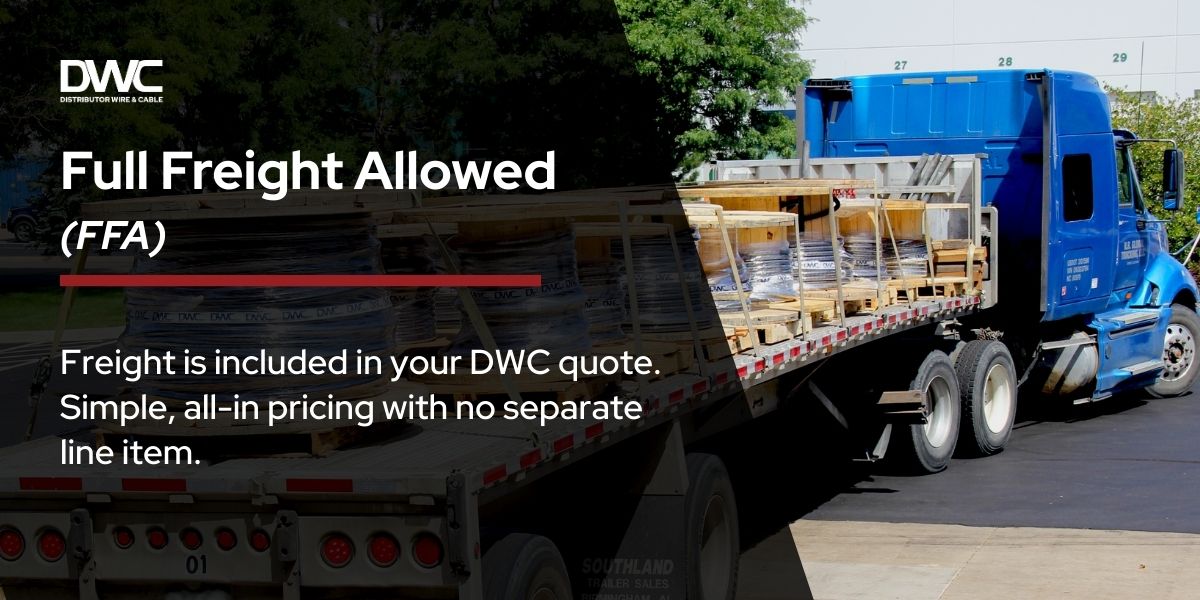
Full Freight Allowed (FFA) Freight is bundled into product pricing. One clean number on your quote with shipping already included. Best for straightforward pricing presentations and larger shipments where you want simplified accounting.
Example: A distributor ordering a full truckload of cable uses FFA to simplify quoting since freight is already built into the cost.
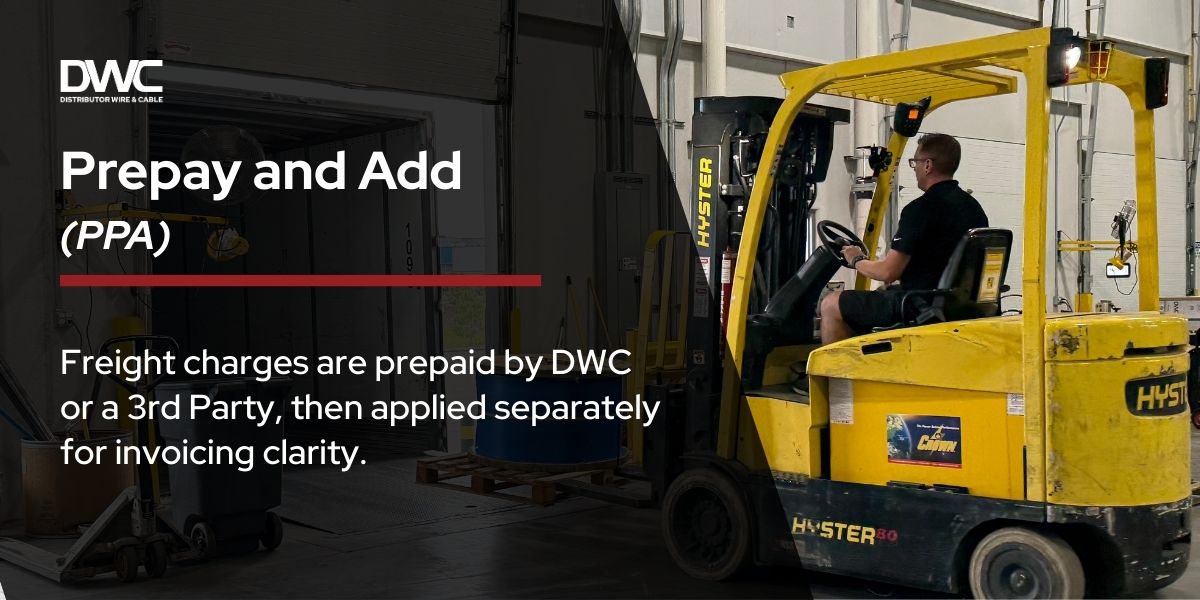
Prepay and Add (PPA) Your supplier handles freight arrangements and pays the carrier, then adds the actual freight charge as a separate line on your invoice. Gives you freight visibility without the coordination burden. Ideal when you need itemized expenses for job costing or reimbursement.
Example: A distributor selects PPA so freight appears as a standalone expense on their invoice.
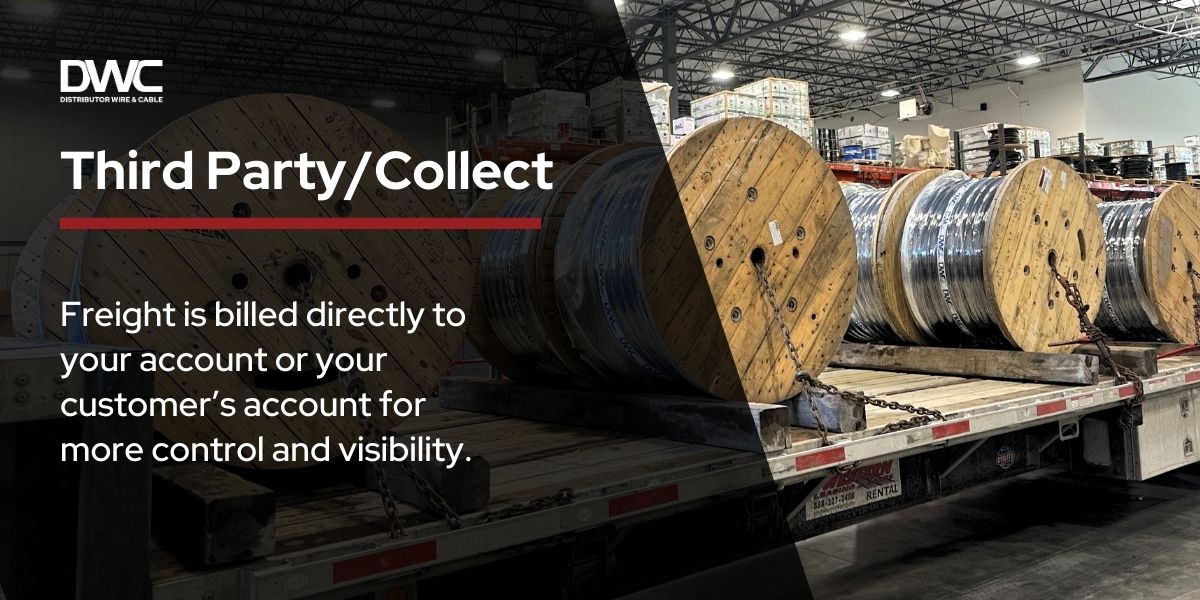
Third Party / Collect Freight bills directly to your carrier account (Collect) or your customer's account (Third Party). Maximum control over carrier relationships and pricing. Essential when you've negotiated volume rates with national carriers or need consistency across all vendors.
Example: A distributor with a national UPS account chooses Collect billing so all shipments run through their negotiated rates.
Hot Shot / Expedited Direct, non-stop delivery for critical situations. Premium pricing for premium speed. Reserved for project emergencies, equipment failures, or when delay costs exceed freight premiums.
Now let's explore how these options work in the context of electrical cable shipping, where weight, dimensions, and handling requirements create unique considerations.
Shipment Types: Right-Sized for Every Order
Along with delivery modes, DWC also offers different shipment types depending on order size and weight:
Full Truckload (FTL): A dedicated truck for one large order. Best for bulk shipments that maximize capacity.
Less Than Truckload (LTL): Shares truck space with other freight. Cost-effective for mid-sized orders.
Ground (UPS): For shipments under 150 lbs., delivered through standard parcel networks.
Hot Shot (Expedited): For urgent situations, DWC can arrange direct, non-stop delivery. Best for critical orders where every hour matters.
Example: A distributor’s customer experiences a transformer failure late Friday. Hot Shot delivery ensures replacement components arrive Saturday morning, avoiding downtime.
Understanding Freight Classification for Electrical Cable
Electrical cable presents particular challenges in the freight world because it defies easy categorization. A reel of 15kV medium voltage cable might weigh 3,000 pounds but occupy significant cubic space due to the reel dimensions. Building wire on smaller spools might be dense and compact, while large reels of aluminum conductor require specialized handling.
The National Motor Freight Classification (NMFC) system categorizes freight into 18 classes ranging from 50 to 500, with lower numbers representing dense, easy-to-handle freight that costs less to ship, and higher numbers representing lighter, bulkier, or harder-to-handle freight that costs more. Four factors determine classification: density (weight per cubic foot), stowability (how easily it fits with other freight), handling (special equipment or care required), and liability (risk of damage or value).
Electrical wire and cable typically falls into freight classes ranging from 65 to 85, depending on the specific type and packaging. Insulated copper wire on reels generally classifies as Class 70, while coaxial cable might be Class 65, and some specialty cables could be Class 85. The NMFC code 39350 specifically covers electrical connections and wiring at Class 70, though your specific shipment classification should always be verified based on density calculations and packaging method.
Here's where it matters for electrical distributors: misclassifying freight can result in reclassification fees from the carrier, which means your carefully calculated quote just became unprofitable. When ordering from your master distributor, ensure they're calculating freight class correctly based on actual dimensions and weight, not estimates. A 500-foot reel of 250 MCM aluminum conductor has very different freight characteristics than the same length of #12 copper building wire, even though both are "electrical cable."
Full Freight Allowed: When Simplicity Wins
Full Freight Allowed represents the most straightforward approach to freight billing. When you receive a quote with FFA terms, the price you see includes all transportation costs bundled into the product pricing. There's no separate freight calculation, no carrier selection to make, and no freight invoice to reconcile later. Your purchase order shows one total amount, and that's what appears on your invoice.
This approach shines in several scenarios. When you're preparing quotes for contractors or end-users who want all-in pricing without freight asterisks and footnotes, FFA eliminates the need to estimate shipping separately. The contractor sees a clean number per foot of cable, and that's the basis for their bid. For larger projects where you're buying full truckloads of type: entry-hyperlink id: 4gd14zcPCSLOT39QYaPHQa or industrial facility, FFA simplifies the transaction. The freight cost is proportionally smaller relative to the product value, and having it absorbed into the unit price creates cleaner paperwork.
FFA also works well for distributors who don't want to manage carrier relationships for inbound freight from their suppliers. Your master distributor selects the carrier, manages the pickup, tracks the shipment, and handles any claims if damage occurs in transit. You're effectively outsourcing freight coordination, which has value when your team is focused on sales, customer service, or other high-priority activities.
The tradeoff comes in freight cost visibility and control. When freight is bundled into product pricing, you may not know if you're paying $200 or $800 to ship that reel of cable. For distributors who track freight as a percentage of cost of goods sold or who need detailed job costing for reimbursable projects, this lack of granularity can be problematic. You also can't leverage your own carrier relationships or negotiated rates because the supplier is making the carrier selection. If you've spent years cultivating a relationship with a regional LTL carrier who gives you exceptional service and competitive rates, FFA terms prevent you from using them.
Prepay and Add: The Middle Ground
Prepay and Add offers visibility without coordination burden. Under PPA terms, your supplier or their designated freight forwarder pays the carrier upfront, then adds the actual freight charge as a separate line item on your invoice. You receive the same freight coordination service as FFA, but now you have transparency into exactly what freight cost on that shipment.
This visibility matters for several business reasons. When you're billing customers on a cost-plus basis or working on projects with reimbursable freight expenses, PPA gives you documentation. Your invoice shows the product cost and the freight cost as distinct line items, making it straightforward to mark up appropriately or pass through at cost. For distributors who analyze their freight spending to identify optimization opportunities, PPA provides the data needed to spot trends. You might discover that freight from one supplier consistently runs higher than another, prompting a conversation about carrier selection or shipping consolidation.
PPA particularly appeals to distributors who want supplier expertise in freight coordination but need accounting separation between product and freight costs. Your master distributor has relationships with freight carriers, understands how to properly package and classify electrical cable shipments, and handles claims if issues arise. But you maintain the ability to track freight expenses separately for internal financial analysis or external billing purposes.
The supplier typically uses their carrier relationships for PPA shipments, which means they may have access to better rates than you could negotiate independently for a single shipment. However, you're still not using your own carrier accounts, so any volume discounts or service agreements you've established don't apply to inbound freight from that supplier. For distributors with strong carrier relationships who ship frequently, this represents foregone savings.
Third Party and Collect: Maximum Control
Third Party and Collect billing puts you in the driver's seat for carrier selection and freight management. With Collect billing, freight charges bill directly to your carrier account. With Third Party billing, charges go to your customer's carrier account. In both cases, you control which carrier moves the freight, which service level is used, and how the freight gets documented and tracked.
This approach makes sense when you've invested in building carrier relationships. Maybe you've negotiated a national contract with a major LTL carrier that gives you favorable rates and priority handling. Or perhaps you've developed strong relationships with regional carriers who provide superior service in your geographic markets. Using Collect billing ensures all your inbound freight from suppliers runs through these preferred carriers, allowing you to maximize the volume discounts and service commitments you've negotiated.
For distributors with sophisticated logistics operations, Collect billing provides consistency and visibility across all inbound freight, regardless of supplier. You can track all shipments through a single transportation management system, analyze total freight spend across all vendors, and identify optimization opportunities like consolidation or routing improvements. When a contractor calls asking where their cable is, you have complete visibility because the shipment is moving on your carrier account with your tracking credentials.
Third Party billing extends these benefits to situations where your customer wants freight billed to their account. Large contractors, industrial facilities, and commercial customers often have their own carrier agreements and prefer to control inbound freight to their sites. Using Third Party terms allows them to leverage their carrier relationships while you maintain focus on product sales rather than freight coordination.
The responsibility that comes with control is more logistics management on your end. You need to coordinate pickup times with your supplier, provide carrier information and account numbers, monitor shipments, and handle any claims for damage or loss. For distributors without dedicated logistics staff, this administrative burden can outweigh the cost savings from using your own carriers. You also bear more risk, because if the carrier damages the freight or loses the shipment, you're managing the claims process rather than letting your supplier handle it.
Shipment Types for Electrical Cable: Choosing the Right Truck
Beyond delivery terms, the physical characteristics of your cable order determine which shipping method makes sense. Electrical cable presents unique shipping challenges because of weight distribution, reel dimensions, and handling requirements that differ substantially from typical palletized freight.
Full Truckload (FTL) for Major Projects
Full truckload shipping dedicates an entire 53-foot trailer to your shipment. For electrical distributors, FTL typically makes sense when you're ordering cable for major construction projects, stocking large inventory positions, or consolidating multiple orders for cost efficiency. A utility project requiring 20,000 feet of medium voltage cable, or a data center build needing hundreds of reels of Cat6 and fiber, naturally fills a truck.
FTL provides several advantages beyond just moving large volumes. Transit times are faster because the truck goes directly from your supplier to your location without intermediate stops at freight terminals. This direct movement reduces handling, which matters significantly for cable on reels. Every time a forklift operator loads and unloads a 2,500-pound cable reel, there's risk of damage to the reel flanges, type: entry-hyperlink id: 4DqN8CPYaOStUKOheuimDX, or type: entry-hyperlink id: 3pHHi9P0rzkqd9VhpAduPF FTL shipping means your cable gets loaded once at origin and unloaded once at destination.
Cost per unit typically drops with FTL shipping because you're paying for the entire truck regardless of whether it's 60% full or 100% full. This creates opportunities for creative ordering strategies. You might consolidate orders from multiple branches or customers into a single FTL shipment to your distribution center, then break it down for local delivery. Or you might coordinate with other distributors in your region to share FTL shipments from common suppliers, splitting the freight cost based on weight or volume.
The commitment required for FTL is both financial and logistical. You need to have the inventory capital available to order truckload quantities, the warehouse space to receive and store large shipments, and the material handling equipment capable of unloading heavy cable reels. Your facility needs adequate dock space and clear access for a 53-foot trailer. For smaller distributors or those with space constraints, these requirements can make FTL impractical even when the economics are attractive.
Less Than Truckload (LTL) for Regular Operations
Less than truckload shipping handles freight that's too large for parcel carriers but doesn't fill an entire truck. For electrical distributors, LTL represents the workhorse of routine cable ordering. You're replenishing stock on a few reels of building wire, fulfilling a contractor order for specialty cable, or testing a new product line with smaller initial quantities.
LTL carriers consolidate shipments from multiple shippers into single truckloads, routing freight through hub-and-spoke networks similar to how FedEx handles packages. Your cable shipment leaves your supplier's dock, moves to a regional terminal where it gets sorted and consolidated with other freight heading in the same direction, then moves through one or more additional terminals before final delivery to your location.
This hub-and-spoke system makes LTL economical for smaller shipments, but it also introduces complexity that matters when shipping electrical cable. Each terminal transfer is an opportunity for damage. A forklift operator at a midnight shift in a St. Louis freight terminal doesn't know that the reel he's moving contains expensive 15kV cable that requires careful handling. He's moving hundreds of pallets per shift, and if that cable reel isn't properly packaged and secured, damage can occur without anyone noticing until it arrives at your dock.
Proper packaging becomes critical for LTL cable shipments. Cable reels should be secured to heavy-duty pallets with adequate banding, shrink-wrapped to prevent moisture infiltration and reel rotation, and labeled with handling instructions and freight class information. Smaller quantities of cable in boxes need to be palletized properly with corner boards and stretch wrap that prevents shifting. The few dollars spent on quality packaging can prevent hundreds or thousands of dollars in damaged cable claims.
LTL freight classes directly impact pricing, and electrical cable's classification can vary significantly based on density and packaging. A dense, compact shipment of copper building wire might qualify for a lower freight class than a large but light reel of aluminum conductor. Understanding how freight class affects your costs helps you make smarter ordering decisions. Sometimes it's worth combining orders to reach a lower per-pound rate, or splitting an order to avoid dimensional freight charges.
Transit times for LTL typically range from one to five business days for most domestic shipments, with longer times for remote locations or cross-country moves. This predictable but slower timeline means you need to plan ahead more than with FTL or expedited options. That contractor who calls Monday afternoon needing cable for a Thursday morning installation might not be serviceable via standard LTL if your supplier is three states away.
Ground Shipment for Small Orders
UPS, FedEx, and other parcel carriers handle smaller cable shipments, typically under 150 pounds per package. For electrical distributors, ground shipping works for replenishing stock on popular items kept in small quantities, fulfilling contractor orders for a few hundred feet of wire, or shipping cut-to-length cable that doesn't require reels.
Parcel shipping offers speed and convenience for small shipments. Orders placed by noon often ship same day and deliver within one to three days anywhere in the contiguous United States. Tracking is granular and real-time, giving you and your customers precise delivery visibility. The UPS or FedEx driver who handles residential and commercial deliveries knows how to navigate to virtually any address, including job sites and hard-to-reach locations that freight carriers might struggle with.
The weight and size limitations of parcel carriers mean you're limited in what cable products can ship this way. A 50-pound box of 12/2 Romex ships ground without issue. A 300-pound reel of 4/0 aluminum conductor doesn't. For distributors with diverse product lines spanning small building wire to large industrial cable, knowing which products fit parcel parameters helps with inventory positioning and order fulfillment strategy.
Cost per pound is typically higher with parcel carriers than LTL freight, but there's no minimum charge, so very small shipments can be economical via ground. A $15 ground shipment might cost $50 as LTL freight when you factor in minimum charges and accessorials. However, as package weight increases toward that 150-pound threshold, LTL often becomes more cost-effective, creating a crossover point where shipping strategy should shift.
Hot Shot and Expedited Services
Hot shot delivery represents the emergency option when normal freight timelines don't work. A commercial electrician discovers damaged cable on a Friday afternoon for a Monday morning installation. A utility crew encounters unexpected cable failure during a repair. A manufacturing facility needs replacement power cable immediately to avoid production downtime. These scenarios justify premium freight costs because the alternative is worse.
Hot shot services use dedicated trucks that make direct runs from origin to destination without stops or terminal transfers. A driver picks up your cable shipment at your supplier, drives straight to your location or directly to the job site, and delivers it as quickly as possible. Depending on distance, this might mean same-day delivery, overnight delivery, or delivery within a compressed timeframe that would be impossible with standard freight.
The cost reflects the dedicated service. Where standard LTL freight might cost $200, hot shot service for the same shipment could be $800 to $1,500 or more depending on distance and urgency. You're paying for a truck and driver to handle only your freight, and you're paying for speed that requires drivers to work irregular hours or long shifts.
Despite high costs, hot shot services can be economically rational. When a contractor faces liquidated damages of $10,000 per day for project delays, spending $1,200 on hot shot delivery to avoid even a few hours of delay is an obvious choice. When a critical electrical system fails at a hospital or data center, expedited cable delivery is simply the cost of resolving the emergency. The key is using hot shot strategically for genuine emergencies rather than as a band-aid for poor planning.
Most master distributors maintain relationships with hot shot carriers or expedited freight providers who can mobilize quickly when these situations arise. Having these relationships in place before you need them means you can respond rapidly when contractors call with emergency requirements.
Cable-Specific Freight Considerations
Shipping electrical cable differs from shipping general freight in ways that directly affect cost, damage risk, and handling requirements. Understanding these differences helps electrical distributors avoid problems that can turn profitable orders into expensive headaches.
Cable Reel Handling and Packaging
Cable reels present unique challenges in freight transportation because of their cylindrical shape, concentrated weight, and the damage sensitivity of the wound cable. A standard wooden reel of medium voltage cable might measure 6 feet in diameter, weigh 2,500 pounds, and contain $50,000 worth of cable. Proper handling isn't optional.
The industry standard for shipping cable reels involves securing them to heavy-duty wooden cradles or pallets that prevent rolling and protect the reel flanges. The reel should stand upright on its flanges when possible, as this is the most stable orientation and prevents stress on the cable. For smaller reels, multiple units can be secured together on a single pallet, but they should be banded tightly and wrapped to prevent shifting during transit.
Shrink-wrapping cable reels serves multiple purposes beyond just securing the cable to prevent unwinding. It protects against moisture infiltration that could damage insulation, prevents UV exposure during outdoor storage, and keeps the cable clean and install-ready. The modest cost of quality shrink-wrapping pays dividends in preventing damage claims and maintaining cable quality.
When ordering cable on reels, communicate any special handling requirements to your supplier. If the destination has limited material handling equipment, the carrier needs to provide liftgate service. If delivery is to a residential construction site without a forklift, the reel dimensions and weight need to be serviceable with manual handling or a pallet jack. These considerations affect carrier selection and cost but prevent the nightmare scenario of a 3,000-pound cable reel arriving at a location with no means to unload it.
Density and Freight Class Accuracy
Electrical cable's density varies dramatically based on conductor material and size. Copper cable is substantially denser than aluminum. Large conductor sizes concentrate weight in smaller packages. These density variations affect freight classification and pricing.
The proper way to classify cable freight is calculating density by dividing weight in pounds by volume in cubic feet. A 500-pound reel occupying 25 cubic feet has a density of 20 pounds per cubic foot, which would classify as Class 60 or 65 depending on other factors. A 200-pound reel occupying 20 cubic feet has density of 10 pounds per cubic foot, pushing it toward Class 85 or higher.
Carriers sometimes inspect and reweigh shipments at freight terminals. If your supplier classified a shipment as Class 70 but the carrier determines it should be Class 85 based on actual dimensions and weight, you'll receive a reclassification charge that can add 20% or more to the freight cost. This surprise expense erodes margins and creates accounting headaches. Working with suppliers who accurately classify freight based on measured dimensions rather than estimates prevents these problems.
Regional Delivery Challenges
Electrical distributors often serve customers in rural areas, small towns, or remote job sites where freight delivery becomes complicated. Standard LTL carriers have defined service areas, and locations outside these areas either aren't serviceable or require additional fees for extended delivery.
A construction site 30 miles down a county road beyond the last major town might require a "residential delivery" surcharge or "limited access" fee even though it's technically a commercial construction site. A small electrical contractor in a rural area might receive deliveries to his home address, triggering residential delivery fees and liftgate requirements because there's no loading dock or forklift available.
These accessorial charges add up quickly. A shipment with $150 in base freight might accumulate $75 in accessorials for residential delivery, liftgate service, and limited access, increasing total cost by 50%. Understanding which customer locations trigger accessorials helps with quote accuracy and margin protection. Some distributors build these costs into their pricing for remote customers, while others itemize them separately to maintain transparency.
Strategies for Reducing Freight Costs
Freight represents a significant expense for electrical distributors, often ranging from 3% to 8% of cost of goods sold depending on order patterns and customer locations. Strategic approaches to freight management can improve margins without requiring customers to absorb cost increases.
Consolidation and Order Batching
The most powerful freight optimization strategy is consolidation. Instead of placing multiple small orders throughout the week that each ship LTL, batch orders to reach FTL thresholds or at minimum create larger LTL shipments that benefit from better per-pound rates. A single 5,000-pound LTL shipment costs far less per pound than five separate 1,000-pound shipments.
This strategy requires coordination between purchasing and sales. You need visibility into upcoming customer orders so you can consolidate supplier orders that serve multiple customers. Maybe you have three contractor customers who each need different cable types for projects starting next month. Rather than ordering separately as each contractor commits, batch the orders into a single larger shipment from your supplier that gets better freight rates.
The tradeoff is inventory capital and carrying costs. Ordering larger quantities to optimize freight means you're holding more inventory longer, which ties up capital and requires warehouse space. The freight savings need to exceed the inventory carrying costs for the strategy to make economic sense.
Direct Ship to Job Sites
For large contractor orders, direct shipping from your supplier to the job site eliminates one freight move. Instead of supplier to your warehouse then warehouse to job site, the cable goes directly from supplier to contractor. You save on the second freight move while maintaining your distributor margin on the product.
Direct ship works best for major construction projects where contractors are ordering truckload quantities of cable that go immediately into installation. The contractor gets faster delivery, you avoid handling costs and inventory risk, and freight costs are minimized by eliminating the extra move.
The challenge with direct ship is maintaining customer relationships and service quality when you're not physically handling the product. You need confidence that your supplier will deliver on time, package correctly, and respond if problems occur. Some distributors are reluctant to direct ship because it makes them feel like order-takers rather than value-add supply chain partners.
Optimizing Carrier Selection
For distributors using Collect or Third Party billing, carrier selection significantly impacts costs. Not all LTL carriers are equally competitive in all lanes or for all freight types. A carrier with excellent rates and service in the Southeast might be expensive in the Northwest. A regional carrier with a strong network in a particular state might beat national carriers on price and service within that geography.
Testing different carriers on similar lanes helps identify which carriers offer the best combination of price and service for your typical shipments. Track delivery performance, damage rates, and customer feedback alongside costs. The cheapest carrier isn't the best choice if they consistently miss delivery windows or damage freight.
Many distributors benefit from establishing preferred carrier relationships where you commit to volume targets in exchange for better rates. These agreements work best when you can actually deliver the volume commitments and when the carrier's network aligns well with your shipping patterns.
Common Questions About Electrical Cable Freight
How much does it cost to ship electrical cable?
Freight cost for electrical cable depends on weight, dimensions, distance, and delivery requirements. As a rough benchmark, LTL freight for cable typically ranges from $0.40 to $1.20 per pound depending on distance and freight class, with minimum charges of $100 to $200 per shipment. A 500-pound reel of cable shipping 800 miles might cost $250 to $400 in LTL freight. FTL shipping eliminates per-pound calculations in favor of fixed rates based on distance and equipment type, typically $1.50 to $3.00 per mile depending on market conditions and equipment requirements.
Actual costs vary significantly based on specific circumstances. Residential delivery, liftgate service, inside delivery, notification requirements, and other accessorial services add to base freight costs. Remote locations or areas with limited carrier service command premium rates. Time-sensitive shipments requiring expedited or hot shot delivery cost substantially more than standard transit times.
The best way to estimate freight cost for a specific order is requesting quotes from carriers based on actual dimensions, weight, and delivery requirements. Most LTL carriers provide instant online quotes through their websites or through freight broker platforms.
What freight class is electrical wire and cable?
Electrical wire and cable typically falls into freight classes 65, 70, or 85 depending on the specific product type, density, and packaging method. The National Motor Freight Classification code 39350 covers electrical connections and wiring at Class 70, which is common for insulated copper wire on reels. Coaxial cable and some other specialty cables might classify as Class 65. Lighter, less dense cable products or those packaged inefficiently might reach Class 85.
Freight class is properly determined by calculating density (pounds divided by cubic feet) and considering handling requirements and liability. A dense, compact cable shipment earns a lower classification than a bulky, light shipment. Proper packaging that maximizes density while protecting the cable can improve freight classification and reduce costs.
Verifying freight class with your supplier or carrier before shipping prevents reclassification charges that occur when carriers inspect shipments and determine the original classification was incorrect.
Should I use my own freight carrier or let my supplier handle shipping?
The answer depends on your carrier relationships, order volumes, and internal logistics capabilities. If you've negotiated favorable rates with carriers through volume commitments or national contracts, using Collect billing to leverage these rates typically saves money compared to supplier-selected freight. The savings percentage varies but often ranges from 10% to 30% on LTL shipments when you have strong carrier relationships.
However, using your own carriers requires logistics management on your end. You coordinate pickups with your supplier, track shipments, and handle claims if damage occurs. For distributors without dedicated logistics staff, this administrative burden can outweigh the cost savings. In these cases, Prepay and Add or Full Freight Allowed terms let your supplier handle freight coordination while you focus on sales and customer service.
A hybrid approach works for many distributors. Use Collect billing for large, regular shipments where your carrier relationships provide clear savings. Use supplier freight coordination for smaller, infrequent shipments where the administrative effort exceeds potential savings.
How do I handle freight costs in my customer pricing?
Electrical distributors approach freight costs in customer pricing through several methods, each with advantages and disadvantages. Some distributors mark up freight at the same margin percentage as product costs, treating freight as part of cost of goods sold. Others pass freight through at cost as a separate line item, maintaining transparency with customers while avoiding margin erosion from fluctuating freight rates.
For project work where customers expect line-item pricing, showing freight separately provides transparency and justification for the charge. For stock-and-flow business where contractors are buying smaller quantities regularly, bundling freight into product pricing simplifies transactions and competitive comparison.
The key is consistency within customer segments. If your competitors show freight separately, bundling it into your pricing might make you appear more expensive even if your total price is competitive. Conversely, if competitors show all-in pricing and you break out freight separately, customers might perceive your pricing as higher due to the way it's presented.
What happens if cable arrives damaged?
Freight claims for damaged cable are resolved through a process that begins at delivery. When accepting a cable shipment, inspect it before the driver leaves. Look for obvious damage to reels, crushed boxes, torn shrink wrap, or any indication that the freight experienced rough handling. If damage is visible, note it specifically on the delivery receipt before signing. Take photos documenting the damage from multiple angles.
For damage discovered after the driver leaves, most carriers allow a certain period (typically 5 to 15 days) to file a concealed damage claim. Document the damage thoroughly with photos, note the extent of product loss, and retain the damaged cable and packaging as evidence. Contact your supplier immediately to report the damage and begin the claims process.
Claims responsibility depends on your delivery terms. With FFA or PPA terms, your supplier typically manages the claims process with the carrier. With Collect or Third Party billing, you're responsible for filing and managing the claim directly with the carrier. Understanding this responsibility before ordering helps ensure you have the right insurance coverage and know the proper procedures for documentation and claim submission.
Making Freight Work for Your Business
Freight strategy deserves the same attention electrical distributors give to product selection, pricing, and customer service. The decisions you make about delivery terms, carrier selection, and shipment consolidation directly affect your margins, customer satisfaction, and competitive positioning.
Start by understanding your freight cost as a percentage of sales and identifying where you have opportunities for optimization. Are you shipping many small orders that could be consolidated? Are you using supplier freight when your own carrier relationships might be cheaper? Do certain customer locations consistently generate high accessorial charges that aren't reflected in your pricing?
Supporting Distributors Every Step of the Way
No two distributors handle freight the same way, and at DWC, we’re here to support yours. With flexible delivery modes and shipment types, we make it easier to quote with confidence, control costs, and keep your customers on schedule.
Work with your master distributor to find the freight approach that matches your business model. At DWC, we structure freight options specifically to support electrical distributors' diverse needs. Whether you prefer the simplicity of Full Freight Allowed, the visibility of Prepay and Add, or the control of using your own carriers, we adapt to how you run your business.
The goal isn't just moving cable from point A to point B. It's doing it in a way that supports your profitability, serves your customers well, and gives you flexibility to respond as projects and requirements change. That's what makes freight strategy matter.
Ready to optimize how freight works in your electrical cable supply chain? Download our Freight Facts guide for detailed freight terms and classifications, or contact your DWC Account Manager to discuss freight strategies tailored to your business.